
You spent Saturday on the sand at Stockton, aired down (let some air out of the tyres), and floated over the soft stuff. The 4WD did everything you asked, and you drove home grinning. Three weeks later it's parked back in the shed at Mona Vale and something has changed. The brakes have a light squeal they didn't have before. There's a rusty smear creeping along a chassis rail. That's beach driving catching up with you.
Here's the short version. A day on the sand does two things to a 4WD. Sand gets into places it shouldn't, and salt water starts eating metal the moment it dries. The damage is slow and quiet, so most people miss it until a part fails. One habit prevents most of it: a proper wash-down within a day or two, getting fresh water into the underbody, brakes, and driveline, not just the paint.
None of this means you should stay off the sand. Beach driving is one of the best things you can do in a 4WD. It just means the vehicle needs a bit of care afterwards. Here is what happens underneath, and what to check.
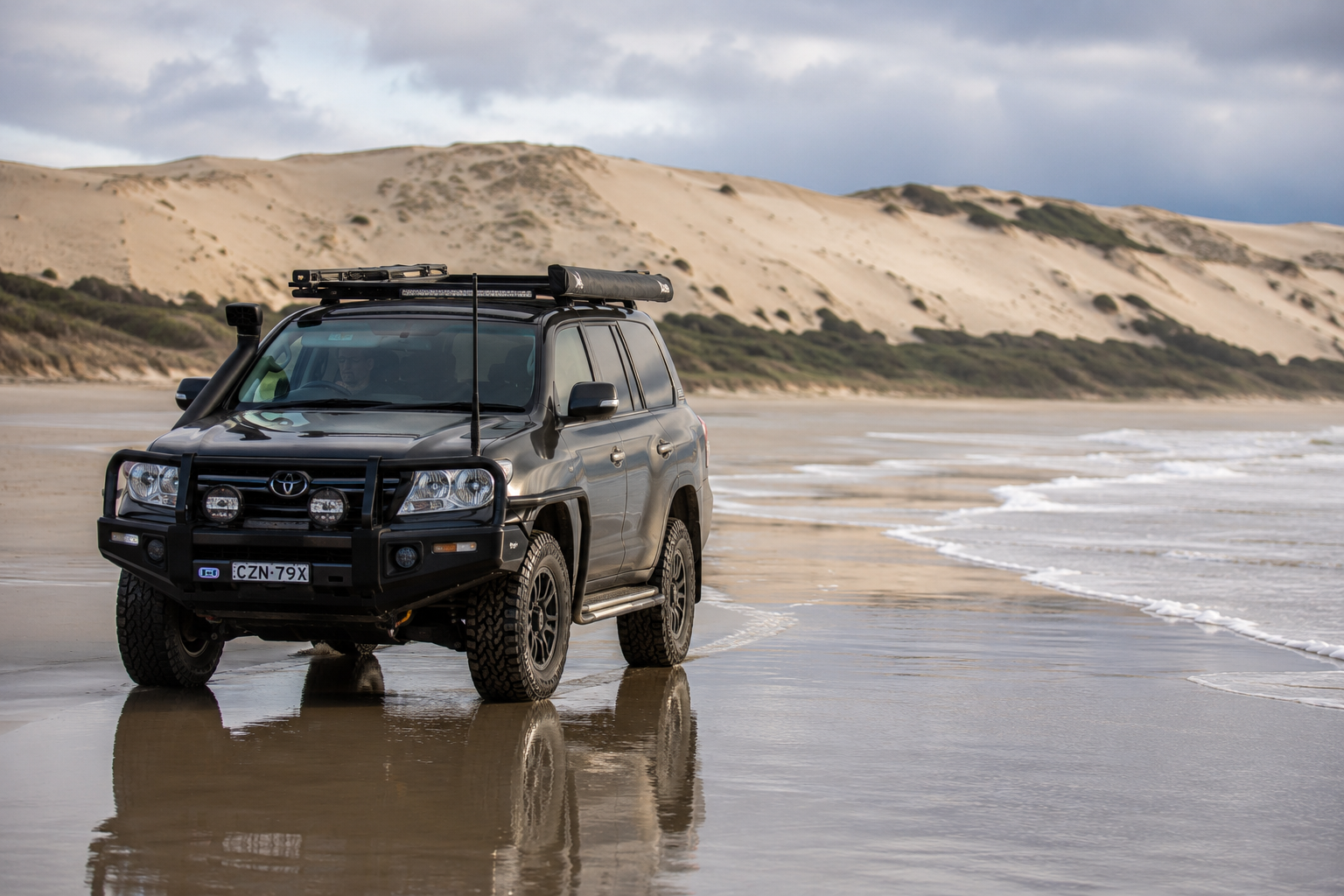
What does beach driving do to your 4WD?
Sand is an abrasive and salt water is a corrosive. Together they work through the parts under your 4WD from the outside in.
- Corrosion on the underbody. Salt water doesn't dry clean. It leaves a film that keeps pulling moisture from the air, so metal keeps rusting long after the beach. Chassis rails, brake and fuel lines, and bare bolts go first. Electrical connectors near the wheels and under the tray are next.
- Brakes. Fine sand works like grinding paste on your discs and pads, wearing them faster. Salt speeds up corrosion on the discs, calipers, and the small slide pins that let the pads move freely. Seized pins mean uneven braking.
- Driveline and CV boots. A CV boot is the rubber cover that keeps grease in and grit out of your front axle joints. Sand and salt water find any small split, wash the grease out, and chew the joint. The torn boot is the thing we pull up most often after a sandy summer. The boot is cheap. The joint it protects is not.
- Air intake. Cross deep water or drive through blowing sand and your engine can breathe in what it shouldn't. Sand through the intake scours the engine. Water through it is far worse and can wreck an engine in one gulp. A snorkel helps, but only if it is sealed properly.
- Radiator and cooling fins. Salt and sand pack into the fine fins at the front of the radiator and air-con condenser. That blocks airflow and makes the engine run hotter, which bites hardest when you are towing in summer.
What tyre pressure should you run on sand?
For soft, dry sand, most mid-weight 4WDs start around 18 psi and drop lower only if they are still digging in. Hard-packed sand near the waterline holds more weight, so you can run a touch higher, around 20 psi. Lighter utes and wagons can go lower. A heavier, loaded rig may need to start higher to keep the tyre sitting on the rim.
Airing down spreads the vehicle's weight over a bigger footprint, so the tyres float instead of sinking. It also protects the whole 4WD. A vehicle bulldozing through soft sand at road pressure runs hot and strains the driveline.
Two rules matter most. Keep your speed down while you are aired down. And reflate to normal road pressure, usually around 32 to 38 psi, before you get back on the blacktop. Driving far on the bitumen with soft tyres builds heat fast and can blow a tyre.
This is about airing down for grip, not about which tyres to fit. If you are weighing up tyre types for sand and touring, that is a separate question we cover in our all-terrain versus mud-terrain guide.
How to wash the salt off after the beach
A rinse within a day or two is the single best thing you can do. Salt keeps working while it sits, so the sooner the better.
A proper wash-down means more than hosing off the paint. Get fresh water underneath: chassis rails, inside the wheel arches, suspension, and the driveline. A lot of people leave a sprinkler running under the parked 4WD for 15 to 20 minutes to reach the spots a hose misses. Rinse the brakes by spraying through the wheels, then do a few gentle stops on the drive home to dry them out.
What a rinse can't reach is the inside of sealed joints, the intake, and any corrosion already started under a bolt or bracket. That is the part that needs a workshop eye, especially if the vehicle went through salt water rather than just driving on damp sand.
Match the exposure to what to check
Here is how the main types of beach exposure line up with what they damage and what to look at afterwards.
| Exposure | What it damages | What to check after |
|---|---|---|
| Driving on damp, salty sand | Underbody, brakes, chassis rails | Rinse the underbody; look for fresh surface rust and any brake squeal |
| Salt water splash or a shallow crossing | Brake parts, electrical connectors, wheel bearings | Brake feel; connectors for corrosion; any new bearing hum |
| Deep water crossing | Air filter, radiator fins, CV boots | Filter condition; fins for packed sand; boots for splits |
| No wash-down for a week or more | All of the above, sped up | Full underbody check; corrosion on lines and mounts |
When is beach damage a safety issue?
Most salt and sand damage is slow corrosion you can stay ahead of. Some of it is a safety problem you can't ignore.
Treat it as urgent if the brakes feel uneven or grabby, or the pedal feels different. Same if the steering develops a new clunk or free play, or you hear a clicking from the front on tight turns. That clicking usually points to a worn CV joint. Those three signs touch braking, steering, and drive, so get a 4x4 mechanic to look them over straight away, not at your next service.
Slow-corrosion issues, like light surface rust on a rail or grime in the fins, can wait for your next service. That holds as long as you have done the wash-down and things are not getting worse.
What does it cost to fix salt and sand damage?
The cheapest fix is the wash-down, and it costs next to nothing. Everything after that depends on how far the damage got.
Catch it early and you stay in cheap territory: a brake clean and adjust, or a new CV boot before the joint is ruined. Leave it, and you move into bigger jobs like a brake line, a full CV joint, or wheel bearings, which can run into several hundred dollars a corner. Water that has got into a diff or the gearbox is dearer again. We won't guess your bill, because it depends entirely on what the salt reached. The pattern is simple though: the longer it sits, the more it costs.
So enjoy the sand. Air down, float over the soft stuff, and rinse the salt off when you get home. After a big beach run, or if you have noticed any of the warning signs above, book a post-beach check or a 4x4 service with the team at Xtreme 4x4 in Mona Vale. We will get eyes on the parts a hose can't reach.