
The 4WD feels fine around town. Then the caravan goes on, the drawers are full, the fridge is packed, the family climbs in, and the rear of the vehicle starts sitting lower than it should. On the freeway, the steering feels a touch light. Over undulations, the rig feels busy instead of settled.
That is the point where heavy caravan towing stops being about the brochure tow rating and starts being about the whole setup.
A safe caravan towing setup needs more than a high towing capacity number. It needs the tow vehicle, caravan, passengers, accessories, payload, GVM, GCM, ATM, towball weight, suspension, tyres, brakes, and cooling system to work together. Xtreme 4x4, based in North Narrabeen and serving the Mona Vale and Northern Beaches 4WD community, works with owners who are setting up rigs for touring, towing, load carrying, and off-road use.
The trap is simple: your 4WD might be rated to tow the van, but it may not have enough payload left once everything is fitted and loaded.
Before adding more gear, ask a few hard questions:
- What does the 4WD weigh with all accessories fitted?
- What does it weigh with passengers, fuel, tools, fridge, drawers, and water?
- What is the caravan's real loaded weight?
- What is the actual towball weight?
- Is the rear axle close to its limit?
- Has the suspension been matched to the load, or just lifted?
- Is the rig legal, stable, and comfortable when loaded the way it is really used?
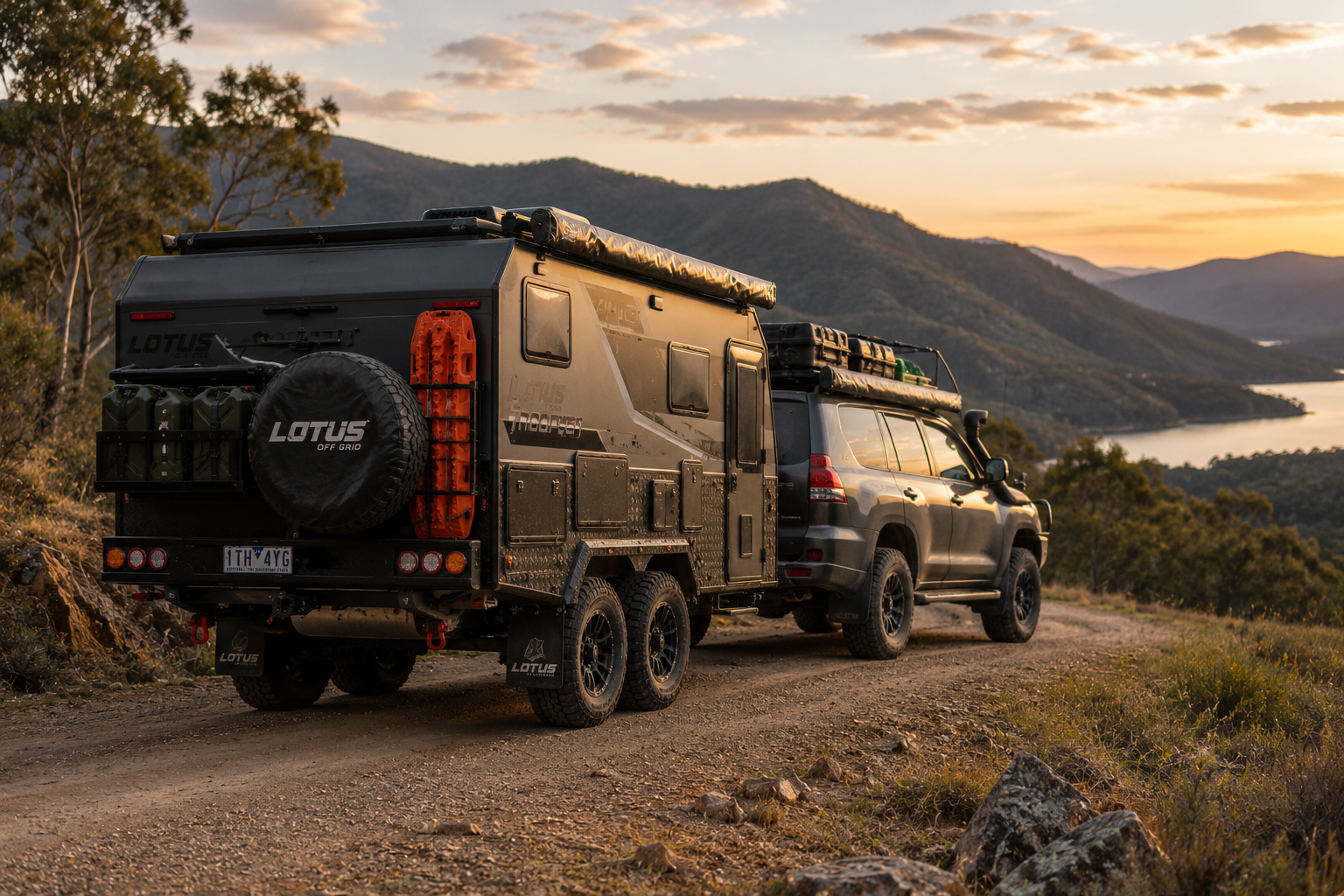
Why towing capacity is not the whole answer
Towing capacity is the maximum weight a vehicle is rated to tow under specified conditions. It is not a promise that you can tow that weight while also loading the vehicle with every accessory and touring item you own.
A common 4WD towing mistake is treating a 3,500 kg braked towing rating as the only number that matters. It is not. That figure does not cancel out GVM, GCM, axle limits, tyre load ratings, towball limits, or the weight of the gear fitted to the vehicle.
The moment you start building a touring 4WD, payload disappears quickly. A serious touring setup can include:
- Bull bar
- Winch
- Driving lights
- Dual battery system
- Canopy
- Drawer system
- Fridge
- Compressor
- Recovery gear
- Long-range tank
- Roof rack
- Awning
- Water storage
- Tools and spares
- Bigger tyres
- Towbar
- Passengers and luggage
None of that is imaginary weight. It all counts somewhere.
The harder truth is that the caravan can also load the 4WD. Towball weight sits on the rear of the tow vehicle, so the van can eat into the payload before anyone has packed a chair, a recovery kit, or a second fridge.
What is the towball trap?
Towball weight is the downward load the caravan applies to the towball of the towing vehicle. It is also called towball mass, ball load, or towball download.
The towball trap is that this weight usually comes out of the tow vehicle's payload. It does not just belong to the caravan. It pushes down on the back of the 4WD and becomes part of the loaded vehicle calculation.
Here is the simple version.
| Item | Example weight |
|---|---|
| Vehicle payload available | 750 kg |
| Towball weight from caravan | 280 kg |
| Bull bar, winch, lights, and towbar | 120 kg |
| Drawer system, fridge, tools, and recovery gear | 170 kg |
| Two adults and two kids | 240 kg |
| Payload remaining | -60 kg |
This is only a round-number example, not a substitute for weighing your own setup. The point is that the margin can disappear fast.
A 4WD can look tough, feel strong, and still be overweight. It can also sit under one limit while breaching another. For example, the vehicle might be under GVM but close to the rear axle limit because the towball, drawers, fridge, water, canopy, and tools are all behind or near the rear axle.
That is why serious towing setups should be weighed, not guessed.
Payload, GVM, GCM and ATM in plain English
These terms get thrown around in caravan and 4WD groups, but they matter because each one answers a different question.
| Term | What it means | Why it matters when towing |
|---|---|---|
| Payload | The weight the vehicle can carry above its empty or kerb weight | Accessories, passengers, luggage, tools, water, and towball weight can all reduce the remaining payload |
| GVM | Gross Vehicle Mass. The maximum loaded weight of the tow vehicle | The 4WD must stay under this limit when loaded as used |
| GCM | Gross Combination Mass. The maximum combined weight of the loaded tow vehicle and loaded trailer | A vehicle may not be able to tow its maximum trailer rating while also carrying a full vehicle load |
| ATM | Aggregate Trailer Mass. The maximum loaded weight of the caravan when unhitched | The caravan must stay under this limit when packed for travel |
| Towball weight | The downward force the caravan applies to the towball | This usually counts against the tow vehicle's payload and loads the rear axle |
| Kerb weight | The vehicle's base weight with fluids and usually a full fuel tank, depending on the manufacturer definition | Payload is worked out from the difference between kerb weight and GVM |
The big one for touring rigs is this: GVM and towing are linked by load. If the vehicle is already heavy before the van goes on, the caravan can push it over the edge.
When does suspension need attention?
Suspension needs attention when the loaded 4WD no longer sits, steers, brakes, or tracks properly under its real touring load.
A lift kit alone is not the answer. A 4WD towing a heavy caravan needs spring rate, shock control, alignment, tyre load rating, brake condition, and weight distribution to be considered together.
Watch for these signs:
- The rear sits low once the caravan is hooked up
- The front feels light or vague at speed
- The vehicle wanders or needs constant steering correction
- The rear suspension bottoms out over dips or gutters
- The headlights point too high after loading
- Tyres wear faster on the inside edge or shoulders
- The rig feels unsettled when trucks pass
- The vehicle pitches or bounces after bumps
- Braking feels less stable when loaded
- The steering wheel no longer sits straight after suspension work
Hardcore 4WD owners often talk about flex, clearance, and articulation. Those things matter off-road. For towing, control matters just as much. A loaded tow rig needs to recover cleanly after bumps, hold alignment, keep the tyre contact patch working, and avoid turning the rear of the vehicle into a pendulum.
Springs hold the weight. Shocks control the movement. Bushes and arms keep geometry in line. Alignment brings the steering and tyre contact back into range. If one part is wrong, the whole setup can feel ordinary.
When is GVM part of the conversation?
GVM becomes part of the conversation when the loaded 4WD is close to, or over, its legal loaded weight limit.
A GVM upgrade is not just heavier springs. It is a legal and engineering pathway that changes the approved gross vehicle mass of the vehicle. The exact path depends on the vehicle, parts, timing, registration status, and approval requirements.
A suspension upgrade can improve ride height, control, stability, and load handling. That does not automatically mean the vehicle can legally carry more. If the paperwork does not change the approved GVM, the legal carrying limit has not changed.
For serious touring builds, GVM should be discussed before the vehicle is fully loaded with accessories. It is much easier to plan the build properly at the start than to bolt on every accessory, hook up a big van, weigh the rig, and discover the numbers do not work.
A proper GVM discussion should include:
- Current vehicle weight
- Planned accessories
- Normal passenger load
- Caravan towball weight
- Rear axle load
- Tyre load rating
- Suspension choice
- Certification requirements
- Whether GCM becomes the next limit
There is no point increasing one number if another limit still catches the setup.
How should a towing setup be checked?
A towing setup should be checked with the vehicle loaded as it is really used. Guessing from brochure numbers is not good enough for a heavy caravan and modified 4WD.
Use this checklist before adding more suspension or towing gear:
- Weigh the tow vehicle loaded for travel, with passengers if possible
- Weigh or confirm the caravan's loaded ATM
- Measure actual towball weight
- Check front and rear axle loads
- Compare the setup against GVM and GCM
- Check towbar and coupling ratings
- Check tyre load ratings on the 4WD and caravan
- Set tyre pressures for loaded towing, not empty commuting
- Measure rear sag with the caravan attached
- Inspect springs, shocks, bushes, arms, and mounts
- Check brake condition on the tow vehicle
- Check the caravan brake controller setup
- Check cooling system health before long climbs
- Recheck wheel alignment after suspension changes
- Reweigh after major accessories are added
A proper loaded check can change the build plan. It may show that the vehicle needs springs and shocks. It may show that weight needs to be moved. It may show that the caravan is heavier than expected. It may show that the rear axle is the real problem, not the headline GVM.
What should you tell Xtreme 4x4?
The best way to start the conversation is to describe the real setup, not just the vehicle model.
Use this line when calling or booking:
"I tow a [caravan weight/type], the car has [accessories], and it feels [saggy/light/wandering]. Can you check the loaded setup before I add more suspension or towing gear?"
Bring as much detail as you can:
- Vehicle make, model, year, and engine
- Current suspension setup
- Tyre size and load rating
- Bull bar, winch, canopy, drawers, roof rack, and other accessories
- Caravan make, ATM, tare, and measured towball weight if known
- Where the vehicle sags or feels unsettled
- Whether the issue happens empty, loaded, or only with the van attached
- Whether the vehicle has already had a lift kit or GVM work
- Any alignment or tyre wear issues since towing
For a serious 4WD owner, the goal is not just "make it sit level". The goal is to build a towing setup that works when the rig is hot, loaded, climbing, braking, turning, and dealing with rough roads.
Frequently Asked Questions
Towball weight usually counts as part of the tow vehicle's loaded weight, so it reduces the payload available for passengers, accessories, tools, luggage, and touring gear.
This is why a heavy van can overload the 4WD before the caravan itself reaches its ATM. The downward load on the towball is carried by the vehicle, and most of that effect is felt around the rear of the 4WD.
If the van has 280 kg on the ball, that is not just a caravan number. It is load the vehicle has to carry.
A suspension upgrade does not automatically increase GVM. It may improve ride height, control, shock performance, and load handling, but the legal GVM only changes when the correct compliant upgrade and approval pathway are completed.
This distinction matters. Stronger springs may stop the rear from sagging, but they do not change the compliance plate or registration record by themselves.
If the vehicle is close to its limit, the conversation should be about both mechanical control and legal load capacity.
A 4WD sags when towing because the caravan adds weight through the towball and shifts load onto the rear of the vehicle. Rear accessories, drawers, canopy weight, water, tools, spare parts, and luggage can make the sag worse.
Sag is not only about appearance. It can affect steering feel, headlight aim, front-end grip, rear suspension travel, tyre wear, and braking stability.
The fix depends on the cause. It may involve different springs, better shocks, load redistribution, tyre changes, alignment correction, or a broader GVM discussion.
Yes. A loaded weigh gives the workshop real numbers to work from before choosing springs, shocks, or a GVM pathway.
Without weights, suspension selection becomes guesswork. The vehicle might be built for a load it rarely carries, or underbuilt for the load it sees every trip.
For touring and towing setups, weigh the vehicle as close as possible to real travel condition. Include fuel, passengers, tools, fridge, drawers, recovery gear, water, and the caravan on the towball if that is how the vehicle is used.
Getting the towing setup right before the next trip
Heavy caravan towing exposes weak points fast. A standard 4WD might feel fine until the van, accessories, family, water, fuel, and gear all land on the same setup.
The towball trap is that the caravan does not just sit behind the vehicle. It loads the vehicle. Once that is understood, the build becomes clearer.
The right setup starts with weights, not guesses. From there, suspension, alignment, tyres, brakes, cooling, and GVM can be looked at properly.
If your 4WD sits down at the rear, feels light through the steering, wears tyres differently after towing, or feels nervous at highway speed, get the loaded setup checked before bolting on more gear.