
Most 4WD problems from a hard trip don’t show up on the trip. They show up two weeks later. An oil patch under the diff in the driveway. A knock from a shock on the morning commute. Brakes that grab on the school run.
At Xtreme 4x4 in North Narrabeen, we see this pattern every week on rigs coming back to the Northern Beaches from the Watagans, Stockton, and longer runs up the NSW coast. The damage happens on the tracks. The symptoms turn up at home. This article is what to watch for in those first two weeks, and why a post-trip inspection at a 4x4 mechanic is cheaper than waiting for the failure on the next run.
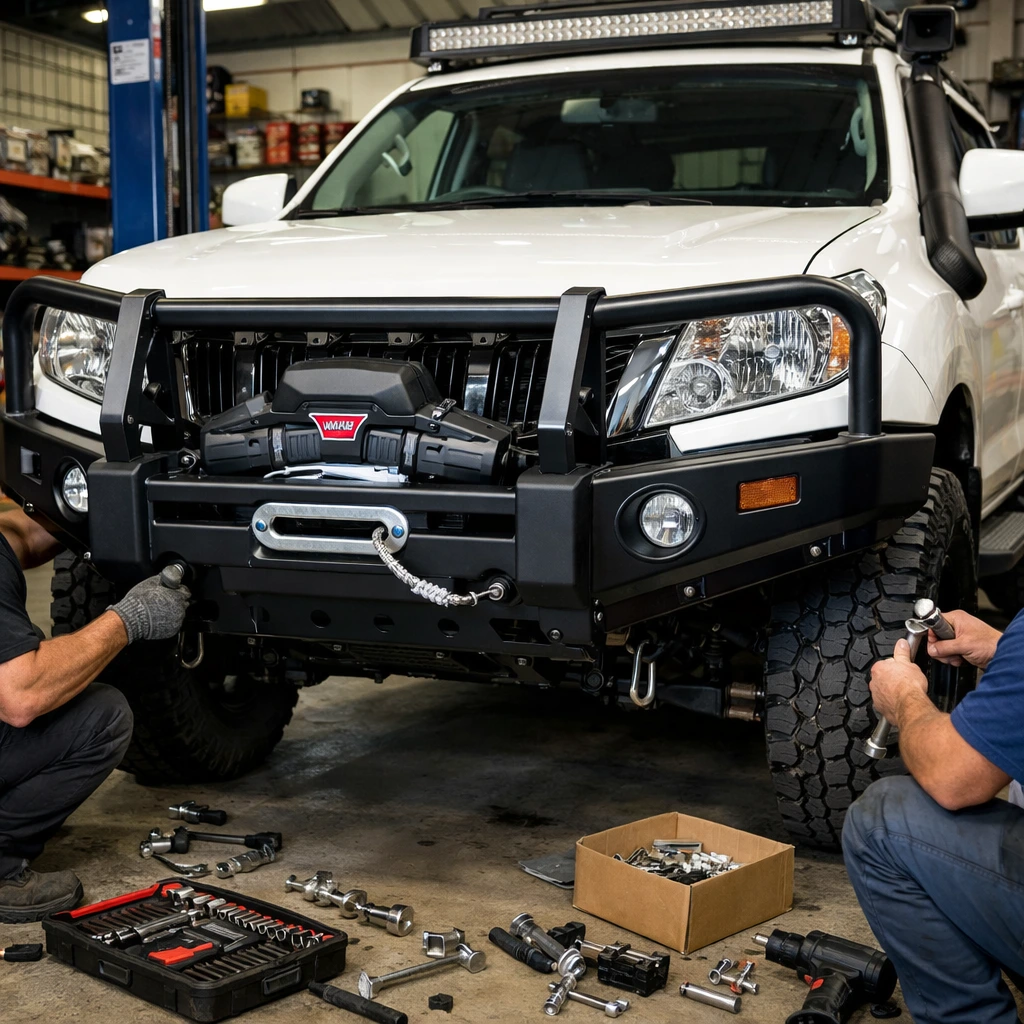
Quick check: what to look at in the first two weeks home
| Area | First sign | If you ignore it |
|---|---|---|
| Suspension | Oil film on shocks, ride height drop, new bush creak | Failed shock or broken spring on the next trip |
| Drivetrain | Diff oil weep, prop shaft clunk, transfer case whine | Pinion seal failure, uni-joint let go, gear damage |
| Brakes | Pull under brakes, ABS warning light, new rotor noise | Calliper drag, rotor scoring, longer stopping distances |
| Cooling and electricals | Coolant drop, sheen on radiator, intermittent fault codes | Overheat or roadside breakdown |
| Tyres and wheels | Sidewall cuts, slow leaks, new wheel play | Blowout under load on the next trip |
Suspension wear after a hard trip
A loaded 4WD on rough tracks works the suspension harder in a week than most road cars see in a year. The wear is real but quiet. It usually shows up in four places.
- Shock absorber oil on the body. A fine film of oil around the shaft or down the side of the shock is the early sign of seal failure. Dirt sticking to a clean shock is a tell. By the time it’s a visible puddle, the shock is done.
- Spring sag from sustained load. Park on level ground and measure from each guard to the centre of the hub. A few millimetres of asymmetry side-to-side, or a noticeable drop from your usual ride height, points to a tired coil or a cracked leaf.
- Bush noise on slow-speed turns. A creak or groan from the front end while you’re crawling out of the driveway is usually a control arm bush starting to fail. The bushes get hammered on corrugated dirt and don’t always make noise at speed.
- Control arm and ball joint play. Lift the front wheel off the ground, grab it top and bottom, and rock it. Movement that wasn’t there before the trip is a ball joint or a worn control arm bush.
If the handling itself feels off after a recent suspension upgrade, that’s a different conversation. We’ve covered that in detail in our piece on how 4WD handling changes after a suspension upgrade.
Drivetrain problems after a long trip
Drivetrain damage from a long trip is slow. Heat, water, and sustained load break things down over weeks, not minutes. Four patterns worth checking.
- Diff oil weeping at the rear pinion seal. A wet sheen at the back of the diff is a pinion seal that’s started to leak. Common after deep water crossings. A hot diff housing dunked in cold water pulls moisture past the breather and the seals. If the oil looks milky on the dipstick, water has got in and the gears are wearing every kilometre.
- Diff oil intervals after a trip. Australian workshops typically recommend a diff oil change every 30,000 to 40,000 km in normal service. If the rig regularly runs through mud and water crossings, drop that to around 10,000 km, or check the oil after every significant trip. Milky oil is a same-week job, not a next-service job.
- Prop shaft uni-joint freeplay. Uni-joints are the cross-shaped joints at each end of the prop shaft that let it flex as the suspension moves. A clunk on takeoff or rolling off the throttle usually means there’s wear in a uni-joint. Catch it early and it’s a uni-joint swap. Leave it and the prop shaft can let go.
- Transfer case whine on tight turns. A low whine or a grinding feel that only shows up in low range, or on tight low-speed turns, points to transfer case oil that’s broken down or chain wear from sustained off-road load.
- Gearbox synchro wear from cold camp starts. Synchros are the brass rings that match gear speeds when you change gear. Repeated cold starts in remote camps, followed by immediate loaded driving, wear them faster than commuter use. A second-gear crunch on cold mornings is the early symptom.
Brake problems after off-road or beach driving
Brakes on a 4WD see two extremes on a long trip. Sustained downhill use with the vehicle loaded. Constant grit and saltwater contamination on beach runs. Both leave a footprint.
- Calliper slide-pin seizure from grit and salt. Slide pins are the metal rods that let the brake calliper move across the pad as it wears. Sand and salt water dry into the slide-pin boots and stop the calliper sliding cleanly. The first symptom is uneven pad wear or a pull to one side under brakes.
- Pad glazing from long descents. A long, loaded descent overheats the pad surface and hardens the friction material. The pedal still works. But stopping distance grows, and you’ll smell brake on the next steep run.
- Rotor scoring from sand-blasted pads. Pads that have collected grit on a sand trip will groove the rotors over the next few hundred kilometres of normal driving. A new noise on light braking that wasn’t there before the trip is the early sign.
- ABS sensor contamination. The ABS sensor reads a toothed ring on the hub and feeds wheel speed to the ABS module. Mud and salt water foul the sensor face. An ABS warning light a few days after the trip is the most common symptom, sometimes with a soft pedal as the system disables itself.
Cooling, electricals, and water-crossing damage
Cooling and electrical problems are the ones most likely to leave you stranded next time. They’re also the cheapest to catch on a post-trip inspection.
- Coolant level drop. A small drop in the overflow tank after high-load driving is normal. A larger drop, or any sign of coolant on the radiator face or under the front of the engine bay, points to a stressed hose or a clamp that’s worked loose.
- Transmission cooler weep. Most modern 4WDs run a transmission cooler in front of the radiator. Sustained towing and low-range crawl work push transmission temperatures up and stress the cooler lines. An oil sheen on the front of the radiator after a trip is the tell.
- Electrical connector corrosion from water crossings. Water gets into connectors, dries, and corrodes the pins. Symptoms can be random. An intermittent traction control fault. A phantom engine light. A sensor that drops out at random kilometres. A workshop scan after a trip will pick up stored codes that haven’t lit a dash light yet.
- Dual battery voltage drop. A dual battery system that worked all trip can fail in the two weeks after, particularly if the auxiliary was deeply discharged out in the bush. Check the auxiliary’s resting voltage. A reading below about 12.4 V after 24 hours on a charger points to a battery that’s lost capacity.
- Alternator load test. A long trip with the fridge, lights, winch, and air compressor all running puts the alternator under sustained load. A load test in a workshop takes about ten minutes and tells you whether the alternator is still holding its output under load.
Tyres and wheels after a long trip
Tyre and wheel damage is the easiest to spot and the easiest to put off. It’s also the failure mode most likely to ruin the next trip.
- Sidewall damage missed during the trip. Bull dust hides cuts. Wash the rig and look at every sidewall in daylight. A small cut you can ignore on the tar is the start of a blowout under load on the next sand section.
- Slow leaks from a kerb hit or a rock track. A tyre that’s holding pressure today might be losing 5 to 10 PSI a week from a bead leak after a hard hit. The first sign is uneven inflation across the four tyres a week or two after the trip.
- Wheel bearing freeplay from sustained load. Lift each wheel off the ground, grab at 9 and 3 o’clock, and rock it side to side. Any play that wasn’t there before is wheel bearing wear. Loaded touring and long sand sections wear bearings faster than road use.
- Lug nut torque after off-road driving. Lug nut tension can change after sustained off-road use, particularly on alloy wheels. A torque wrench check at your manufacturer’s spec (often in the range of 110 to 140 Nm on common 4WDs, but check your model) is a five-minute job that prevents a wheel coming loose.
For the longer story on tyre wear after a lift kit goes on, we’ve covered that in our piece on tyres wearing fast after a lift.
Book a post-trip inspection within two weeks
Most of what’s above is cheaper to fix at the first sign than to wait for the failure on the next run. A workshop inspection takes one to two hours. A pinion seal caught early is a fraction of the cost of a stripped crown wheel. A weeping shock replaced today is a fraction of the cost of a shock that’s let go on a remote track with the family on board.
At Xtreme 4x4 we run a post-trip inspection on rigs coming back from heavy use. Suspension, drivetrain, brakes, cooling, electricals, tyres, wheels. We can do it as a standalone job or fold it into a 4x4 service while you’re there. If you’ve come back from a heavy trip in the last two weeks, that’s the window to book in. The next problem will turn up in the driveway soon enough. Better to find it now than on the next run.
Call (02) 9979 6655 or book a service online.